Ionian Islands
Seven green islands facing Italy, heirs to 400 years of Venetian presence, where olive groves, sailing, and Robola matter more than postcards.
The Ionian Islands form an arc of seven main islands along the western coast of Greece, facing Italy and Albania. Corfu to the north, then Paxi, Lefkada linked to the mainland by a drawbridge, Ithaca, Cephalonia, Zakynthos, and Kythira further south near the Peloponnese. This archipelago has a distinct character within the country: it was never under Ottoman rule. For 400 years, from 1386 to 1797, Venice established its trading posts, fortresses, and architecture here, followed by periods of French and British rule. This layering explains the arcades of the Liston in Corfu Town, cricket played on the Spianada, and the enduring taste for bourdeto, a fish stew with chili and tomato served in tavernas in Garitsa.
The climate differs markedly from that of the Cyclades. The Ionian Sea captures weather systems moving in from the northwest, and the archipelago receives 900 to 1100 mm of rainfall annually, mostly between November and March. The visible consequence: vegetation stays green through much of summer. Cypress, centuries-old olive groves (Corfu has roughly 4 million trees, planted under Venetian administration), Aleppo pine forests, and fragrant maquis. On Cephalonia, Mount Enos rises to 1,628 meters and shelters an endemic forest of firs, Abies cephalonica, designated a national park.
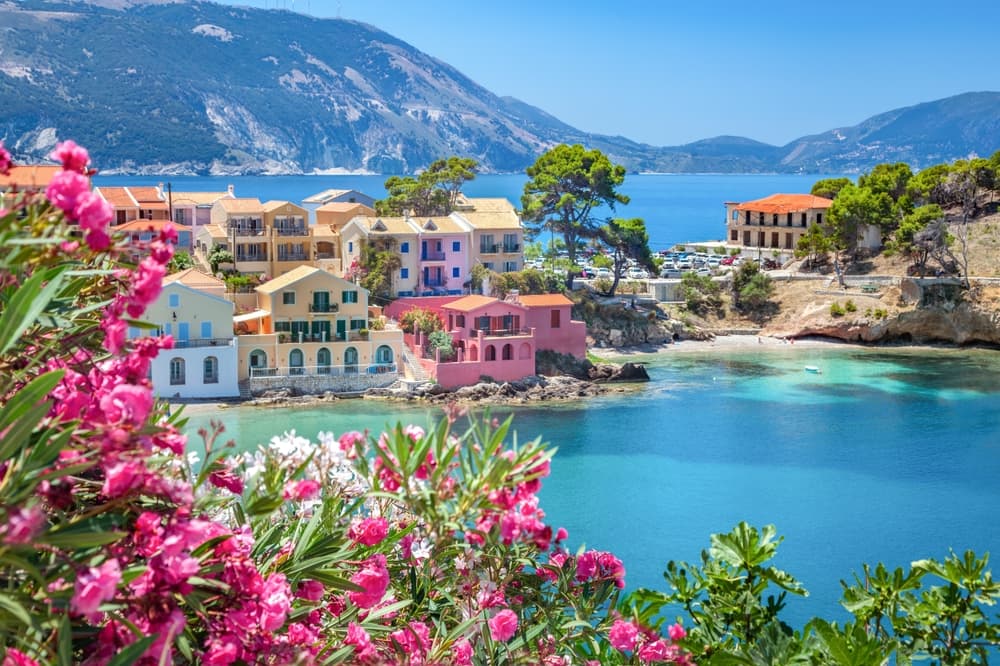
Each island has its own character. Corfu is the most populous and cosmopolitan, with a historic center inscribed on the Unesco list for its intact Venetian urban planning. Cephalonia plays on contrasts: the limestone cliffs of Myrtos, the karstic caves of Melissani and Drogarati, the village of Assos clinging to its isthmus. Zakynthos, lower-lying, blends agricultural plains to the south with cliffs to the north, including the Navagio cliff that everyone has seen in photographs. Ithaca, the island of Odysseus, remains understated and mountainous, with two main ports, Vathy and Frikes. Lefkada seduces sailors with its anchorages to the east, around Nydri and the islets of Meganisi, Skorpios, and Madouri. Paxi, tiny, revolves around three ports: Gaios, Lakka, and Loggos.
The local economy rests on olive oil, wine (Robola from Cephalonia, a dry white from high altitude), coastal fishing, and of course tourism, highly developed on Corfu and Zakynthos, more measured on Ithaca, Paxi, or Kythira. Sailing holds particular importance here: the Ionian Sea offers moderate thermal winds, around 4 to 5 Beaufort scale in the afternoon during summer, and short distances between anchorages. It ranks among Europe's most accessible sailing basins, explaining the density of nautical bases at Lefkada, Nidri, and Sami.
Culturally, Venetian traces appear everywhere: the twin fortresses of Corfu Town, the Angelokastro citadel, the Kastro of Saint George on Cephalonia. But also deeply observed religious festivals, such as the procession of Saint Spyridon in Corfu four times yearly, or summer chamber music festivals on Paxi. The cuisine stands apart from mainland Greek cooking through Italian influence: pastitsada (meat stewed with cinnamon, served with pasta), sofrito (veal cutlet with garlic and white vinegar), and savoro (fried fish marinated in vinegar and raisins).
We recommend approaching this archipelago for what it is: a green, inhabited territory with its own historical references, not as an Ionian variation of the Cyclades. The rhythm is slower here, the landscapes more wooded, the villages more Continental in their architecture.
Must-see
Corfu Town and its old citadel. The Unesco-listed historic center can be explored on foot: the narrow alleys of Campiello, the arcades of the Liston built under Napoleon, and views from the Venetian fortress toward the Albanian coast, just 3 km away.
Myrtos beach and the village of Assos. On Cephalonia's west coast, Myrtos opens between two 200-meter limestone cliffs. A 15-minute drive away, Assos clings to an isthmus dominated by its 16th-century Venetian fortress.
Sailing among Lefkada's islets. Departing from Nydri, you can reach Meganisi, Kalamos, and Kastos in a few hours. Regular afternoon thermal winds, sheltered anchorages, and fishermen's tavernas at Spartochori and Port Atheni.
Ithaca and the return of Odysseus. A mountainous island of 96 km², traversed by a single main road. The port of Vathy, the Marmarospilia cave identified with the Cave of the Nymphs from the Odyssey, and the eastern coves accessible on foot or by boat.
Robola from Cephalonia. A white grape variety cultivated between 400 and 800 meters altitude on the limestone slopes of Mount Enos. About a dozen estates can be visited around the village of Frangata, including the Robola cooperative founded in 1982.
When to go
High season runs from mid-June to mid-September, with daytime temperatures of 28 to 32°C and sea temperatures of 24–25°C in August. July and August concentrate the crowds, particularly on Corfu, Zakynthos, and Cephalonia, where European charter flights arrive continuously. We prefer May–June and September: temperatures of 22 to 27°C, sea still warm in September (23°C), green vegetation in spring with flowering olive groves and wild orchids on Corfu, golden light in autumn.
Winter is mild but very humid: average temperatures of 12 to 15°C, with rainfall totals that can exceed 200 mm in December. Many hotels and tavernas close from October to April on the smaller islands (Paxi, Ithaca). Corfu Town remains lively year-round thanks to its permanent population. For sailing, the ideal window extends from May through late September, with northwesterly thermal winds known as Maestro, which rise around noon and fall at sunset.
Practical advice
Our recommendation boils down to this: one island, one week. Two islands maximum over fifteen days. Ferry connections exist (Corfu–Paxi, Cephalonia–Ithaca, Lefkada–Cephalonia via Vassiliki–Fiskardo), but schedules are seasonal and connections rarely direct. Corfu has an international airport with direct flights from Paris and several European capitals. Cephalonia, Zakynthos, Lefkada (via the Preveza-Aktion airport on the mainland), and Kythira are also served seasonally. Ithaca and Paxi have no airport and are reached by boat.
The archipelago combines well with Epirus and northern Greece, accessible from Lefkada in less than an hour's drive, to add Meteora, Zagori, or Parga to an itinerary. Combining with the Cyclades or Crete requires a return through Athens and only makes sense for three weeks or longer. Hotel comfort is high on Corfu and Cephalonia (character-filled guesthouses, boutique hotels in former Venetian mansions), simpler on Ithaca and Paxi. The Ionians suit families with children (calm seas, sandy beaches in southern Corfu and Zakynthos), sailing enthusiasts, and contemplative travelers who prefer walking through olive groves to ticking off archaeological sites.