Peloponnese
Peninsula south of Athens where Mycenae, Epidaurus, Olympia, Byzantine Mystras and the stone towers of the Mani unfold along a week-long drive.
The Peloponnese is that great peninsula shaped like a plane leaf, detached from the mainland since the Corinth Canal pierced through in 1893. For our team based in Athens, it's the region we recommend first to travellers with at least a week to spare who want to understand the layering of Greek civilizations without catching multiple ferries. Three hours' drive from Athens airport and you slip into a world of dry mountains, tight-packed olive groves and coastal villages where you still dine with your feet almost in the water, at Tolo or Kardamyli.
Geography dictates everything. Mount Taygetus rises to 2,407 metres and separates Laconia from Messenia, creating two opposing hillsides: arid towards Sparta, more wooded and humid towards Kalamata. To the north, the Erymanthos and Chelmos massifs descend towards the Gulf of Corinth with their gorges, including the Vouraïkos gorge which the little Odontotos rack railway climbs for 22 kilometres between Diakopto and Kalavryta. In the centre, Arcadia is a plateau of stone villages—Dimitsana, Stemnitsa, Karytaina—perched between 900 and 1,100 metres, where winter truly arrives and tavernas serve kid goat with hilopites pasta.
History reads in superimposed layers. Mycenae and Tiryns for the Bronze Age, Epidaurus and its theatre of 14,000 seats still used each summer for the Athens-Epidaurus festival, Olympia nestled in a pine-clad hollow where the Games were held for twelve centuries, Mystras the Byzantine city clinging to Mount Taygetus at 700 metres, and finally the Venetian and Ottoman fortresses: Methoni, Koroni, Pylos with its Bay of Navarino where the Ottoman fleet was destroyed in 1827. Nafplio, the first capital of independent Greece from 1829 to 1834, retains from that era a neoclassical urban layout we reveal on foot in the evening, after the heat subsides.
The south remains the most rugged and singular part. The Mani, a central peninsula descending to Cape Tainaron, one of the southernmost points of continental Europe, is a land of schist and cacti where Maniote families built defensive tower-houses from the seventeenth to the nineteenth century. The village of Areopoli contains dozens of them, Vathia stretches along a ridge like an abandoned film set. To the east, Monemvasia is a 300-metre-high rock linked to the coast by a causeway, its fortified lower town traversed only on foot, no cars. Further west, Messenia offers the long sandy beaches of Voïdokilia and Romanos, and a Koroneiki olive oil agriculture that still structures the local economy.
At table, the Peloponnese has more rural cuisine than the islands. At Kalamata, PDO olive oil and oval black olives; at Sparta, sfela, brined cheese; in Arcadia, gouna (sun-dried mackerel) along the Argolid coast; everywhere savoury pies with goat cheese and wild herbs. The wines of Nemea, based on agiorgitiko grapes, and those of Mantineia, based on moschofilero, are the two appellations our English-speaking driver-guides know well and where we arrange winery stops on request.
To discover
Nafplio as a base for Argolid. Two nights in the old Venetian town are enough to chain together Mycenae in the morning, Epidaurus in late afternoon when the theatre empties of tour groups, and dinner in the port beneath the Bourtzi fortress perched on its islet.
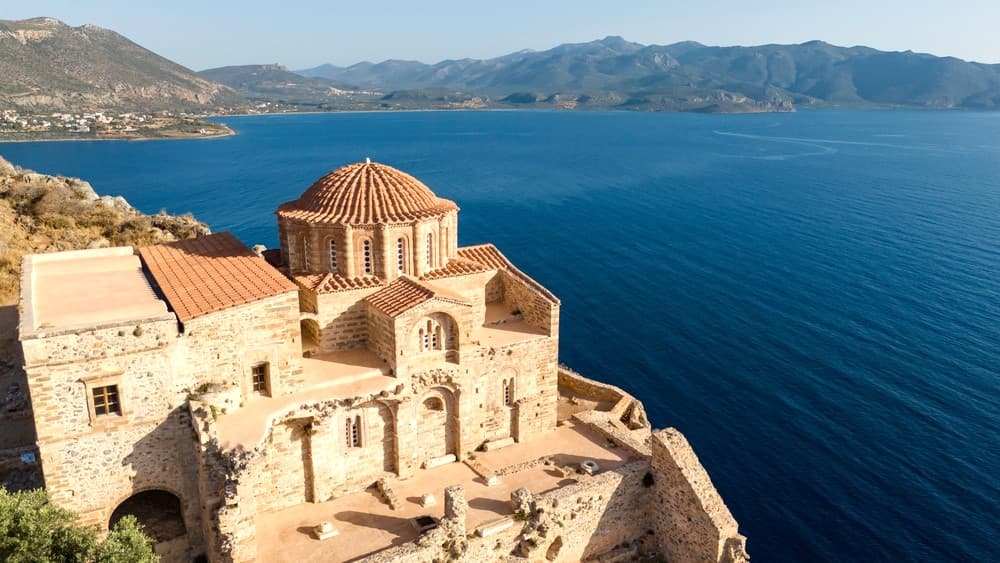
Mystras at the foot of Taygetus. Three hours of walking through the ruined Byzantine city, between the Monemvasia gate and the Pantanassa still inhabited by a handful of nuns. The site climbs from 280 to 620 metres, so bring water and good shoes.
The Mani and its tower-villages. Schist road between Areopoli, Gerolimenas and Vathia, with a detour through the Diros caves visited by boat along a kilometre of underground galleries.
Olympia and the Alpheus valley. The sanctuary at sunrise, before the groups arrive, then the museum to understand the statuary before descending to lunch in a Messenia village. Can be combined with a wine stop at Nemea on the return to Nafplio.
Monemvasia, the inhabited rock. Leave the car on the mainland, cross the 200-metre causeway on foot, and sleep in a stone house in the lower town. The alleyways are paved, no traffic, ideal for a quiet night before heading back towards the Mani.
When to go
We recommend two main windows: April to mid-June and mid-September to late October. In spring, Arcadia and Taygetus are still green, poppies carpet the archaeological sites, temperatures range between 18 and 24°C on the coast and stay cool in the evenings at altitude (8 to 12°C at Dimitsana in April). Autumn offers a sea still 22-23°C into October and clear days for Mystras and Olympia. July and August are hot and dry, 33 to 38°C in the Spartan plain or at Olympia, with archaeological sites offering little shade, which we visit before 10am or after 5pm. High season also brings Greek crowds to the Messenia and Argolid coasts in August.
Winter, December to February, shouldn't be ruled out for contemplative travellers: it rains mainly in November and January (60 to 90mm per month on western slopes), it can snow above 1,000 metres in Arcadia, but major sites remain open, almost empty, and village tavernas serve their winter cuisine. Monemvasia and the Mani suit this season well, provided you accept shorter days.
Practical advice
Allow a minimum of 7 days for a first circuit, 10 to 12 days to include the Mani and Messenia without driving too much each day. The logical entry point is Athens airport: we collect travellers and head straight to Nafplio in 2.5 hours, avoiding a night in the city if time is tight. The return can be made via Kalamata (seasonal airport with flights to several European cities from April to October) to gain a day. A rental car is essential, distances between interior villages are short but mountain roads in Arcadia and the Mani require time: allow for an average of 50 km/h.
The region combines well with Attica and Athens at the beginning or end of your stay, and with the Ionian Islands via the Kyllini-Zakynthos ferry (1h15) or Patras-Cephalonia. For a more contrasting mainland-island combination, we often suggest Peloponnese then a flight from Athens to the Cyclades. Comfort levels range from family guesthouses in Arcadia to charming hotels housed in neoclassical buildings at Nafplio or restored towers in the Mani. This is a destination that speaks to history-curious travellers, walkers (the 75km Menalon trail in Arcadia, Taygetus trails), rural food enthusiasts, and families with children from age 8-9 onwards who can manage site visits.